

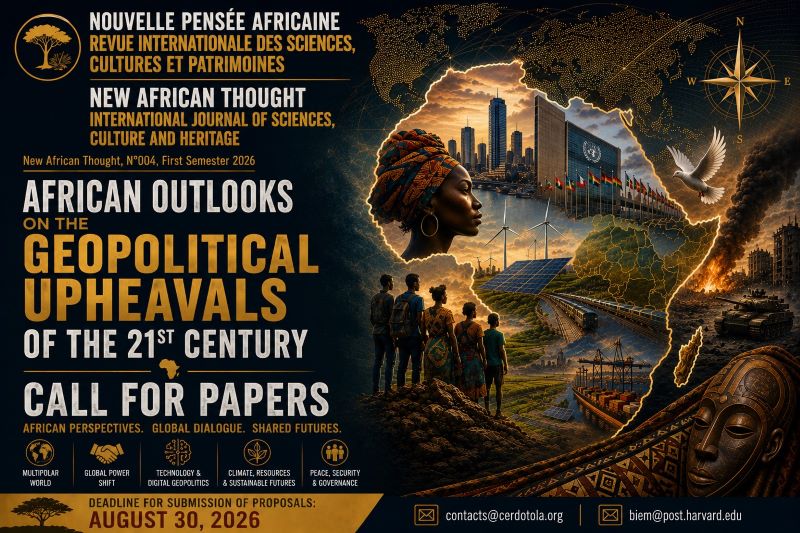
Nouvelle Pensée Africaine, Revue Internationale des Sciences, Cultures et Patrimoines / New African Thought, International Journal of Sciences, Culture and Heritage
New African Thought, N°004, First Semester 2026
African Outlooks on the Geopolitical Upheavals of the 21st Century
CALL FOR PAPERS | APPEL A CONTRIBUTION | Journal Website
CALL FOR PAPERS
It matters little whether it began in 1991 with the triumph of pax capitalista, Western pax democratica and the conflicts induced by the collapse of the most organized anticapitalist alternative in history, or in 2001 with the inaugural battles for and against the global Islamist insurgency that claimed itself as a new alternative. The 21st century is and will clearly be a century of large-scale upheavals. These occur resolutely within the dynamics and meanings of geopolitics, both of the world-system (Wallerstein) and as strategic configurations of regional and global balance (Kissinger). There unfolds, with increasingly extreme violence, the imperium that hegemons seek to impose in the relentless work of defining, exercising, and maintaining power (Negri & Hardt). And this effort allows for reconfigurations of relationships and boundaries between terror and the empire (Hassner) in fluidity, ambiguity and uncertainty.
Meanwhile, at the turn of the century, before the superpower resolved to unilateralism and opted for a strategic doctrine of pre-emptive projection of forces against its designated enemies, assuming the systematic violation of borders and law, Chinese strategists had already conceptualized unrestricted warfare (Liang & Xansui) as a doctrine for ultimately defeating and replacing American hegemony. As China and the Euro-Americans accelerate their movement and clarify the trajectories of collision in the inexorable trends towards global hegemonic transition and the shift of power from the West to the East, the model of territorial limits and sovereignty borders inherited from the Treaty of Westphalia and the Second World War has become obsolete. On all sides, it yields to the primacy of increasingly unbridled brute force.
DOWNLOAD CALL FOR PAPERS | TELECHARGER l’APPEL A CONTRIBUTION
Whereas speculative capitalism has entered a systemic crisis since the great recession of 2008, the pax americana whose prosperity it supported seems to be self-sabotaging through and by inverted totalitarianism (Wolin) and endless war (Tertrais). Since this elusive peace operates through the discriminatory distribution of blank checks and other rights to violate international and humanitarian law with impunity, the fields of tension and fault lines multiply, accumulate, and overlap in a maelstrom of submersions into the uncertain. Also occurred here have many assisted insurgencies in Africa. These were regional test battles of the global hegemonic transition war on the main theatre of weakness and powerlessness, which also happens to be the main denuclearized zone, with ruling classes whose obsession with predation induces an irredeemable renunciation of power. The chaos set in and around Libya was justified by an order and series of formidable and persistent precedents, including the corruption of international law, the manipulation of war in the name of humanity (Jeangène Vilmer), and the circumvention-marginalization of the United Nations and regional organisations such as the African Union. The establishment of a trans-Saharan arc of crisis as the second front of manipulated takfiri terrorism alongside the Middle Eastern crescent of crisis has considerably compromised the security of Africa and destabilized what was beginning to take shape as a structure of international security (Buzan & Waever), whose keys to stabilization are the obvious regional peace-making hegemons deliberately weakened by the decaying order.
Henceforth, the Thucydides trap closing in on the world with the Sino-American rivalry (Allison) is compounded by a new Cold War between Russia and the West, framed in a dual geopolitical model. On one hand, it is the struggle for control of the Heartland on which Russia sits, an old Anglo-American aim (MacKinder, Spykman, etc.) inspired by German geographic Darwinism and geopolitical determinism (Ratzel, Ludendorff, Haushofer), and considered a sine qua non for world dominance. On the other hand, it is a conflict of civilizations between the Roman-Germanic world and the Slavic-Orthodox world, which the Russian hegemon claims to want to contain (Douguin). More favourable to fairer geopolitics of pan-regions as the structure of international security, emerging powers and power ghettos such as Africa (Buhler) are trying to mobilize in the global South to reorganise the world (Badie) into a less arbitrary and less ferocious global order. And everything is being reshaped, with a tendential return of war that the powers and the established order impose or endure in disarray and loss of meaning, with strategies that are at times rear-guard, at times self-destructive. Congo, Sahel, Ukraine, Gaza, Iran, Covid, global inflation, trade wars, climate and environment, shifts in nuclear deterrence doctrine, global-impact crises trigger causalities of such magnitude that there is not a single aspect of the systemic legacy of the two World Wars that is not in jeopardy.
Henceforth in many respects, the 2020s resemble the 1920s. And if trends are not altered, the 2030s will resemble the 1930s. The outcomes of these decades of rising fascisms and conflicts are predictable in terms of large-scale global conflagration. We are clearly in preludes to disaster. Yesterday, the power transition initiated at the end of the nineteenth century by the rivalry between the British hegemon and the rising German power ended in favour of the American outsider. What about tomorrow? What of the eternal African outsider?
Under these conditions indeed, the paradoxical situation and position of Africa call for thinking anew, differently, to reset projections. On the one hand, with an inadequate and ineffective model of union, the continent is still struggling in the trilogy of Unity-Sovereignty-Sorrow (Englebert), with chronic defence and security problems (Tshiyembe) for which its coordinated strategic action capabilities have not evolved significantly since independence. Its new architecture of peace and security has fundamentally and practically changed little. On the other hand, it is from this position of weakness that Africa is now planning its industrialisation and emergence, without yet daring to conceive of the implied rise to power, even though everything should now allow it. Notable in this regard is the ambivalence of the multiplication of partnerships with rival powers, both established and emerging, which carries a dual potential and cross effects that simultaneously weaken Africa and open pathways for her rise to power.
DOWNLOAD CALL FOR PAPERS | TELECHARGER l’APPEL A CONTRIBUTION
If Africa wants to carve a path through these windows of systemic opportunities with a genuine aim to play an active role in the world’s reconfigurations (Agenda 2063), it can usefully activate its historical memory. At the time when the world was rushing towards the catastrophe that would produce a new world order in the mid-20th century, Africa was launching ideas about its renaissance, particularly through the artistic and literary creativity of the Negro Renaissance and Negritude, and politically through the Pan-African Congresses. It is indeed the milestone results of the emancipatory movements and their effects that have led to the current capabilities to renegotiate sovereignty and the right to power. After a century of trial and error, the central question raised by these challenges revolves around African perspectives, the African position, and African proposals and projections in the face of current upheavals. What should be Africa’s message to itself and to the world for its transformation as a lever for global human transformation? What opportunity could Africa represent for the world under these decisive conditions? How can we set the right dynamics in motion in the upheavals underway?
It is to such questions that the fourth issue of the journal New African Thought will be dedicated. It invites African thinkers and leaders to formulate the foundations of this posture of recovery with inventiveness, originality, depth and ambition, out of the box and far from worn-out ideologemes that contribute to the crisis of the world-system in the grip of the unravelling before our eyes. Among these are the geopolitical, geoeconomic, and geostrategic perceptions and representations that currently exist among African peoples, actors, and thinkers, and especially those that intellectuals must formulate to make the construction of African power possible with a prospective horizon, within the adversarial and favourable causalities of the ongoing world rearrangements, aiming for a new world-system with Africa as a key actor. The topics to be addressed will include, but not be limited to:
- African perceptions and representations of the crisis of the world-system;
- African perceptions and representations of the African crisis within the upheavals of the world-system;
- African proposals in or on power transition conflicts;
- African ambitions and capabilities in terms of power;
- General and declaratory strategy; Assessment of the impacts of contemporary power conflicts on Africa;
- The effects of Africans’ strategic mistakes on the strategic behaviour of Africa’s partners;
- Africa’s strengths and their geopolitical significance;
- Media and scientific treatment of these dynamics;
- African solutions to African and global problems;
- Multivariate scenarios of the advent of the new world order and the place of Africa;
- Anticipation and forward-looking strategy necessary for the success of Africa’s ambitions.
Perspectives should focus more specifically on the development of Africa’s permanent security and strategy positions on various essential issues:
- The reform of the international system with fair principles of representation and reference to rules and principles of peaceful conflict resolution;
- The place and role of Africa in the recomposition of the world and the redeployment of north-south-south cooperation;
- The place and role of Africa in favour of a peaceful power transition in the 21st century;
- Africa’s Regional strategic autonomy in a new global architecture of peace and security;
- Robust planning of the comprehensive handling of African security issues by Africans;
- Africa’s right to peaceful power;
- Africa’s federative vocation in favour of its continental state-civilization and its robust planning;
- The renegotiation of all partnerships consistently with Nkrumah’s five principles;
- The reconfigurations of institutions and structures of interests and interaction that could place Africa in the race for symbiotic power.
Article proposals (500-1000 words), in French or English, indicating three to five keywords as well as the institutional affiliation and status of the authors, must be sent simultaneously to the following addresses: contacts@cerdotola.org ; npa@cerdotola.org.
Deadline for submission of proposals: August 30, 2026.
DOWNLOAD CALL FOR PAPERS | TELECHARGER l’APPEL A CONTRIBUTION